
By the TSI CXBPO Team
Some contact center calls should always reach a trained person, whatever your automation rate: a downed-wire report, a disconnection with a medical certificate on file, a payment arrangement your commission regulates, a resident calling a government line about a bill or a benefit. They need judgment, and a regulator can pull the transcript. Automate the routine volume around them.
Sort by queue type, then by volume
Most AI plans start with volume: which calls come in most, and how many can a bot absorb. That’s a fair question for password resets and order status.
In regulated work, the first sort is different. Ask what happens if the call goes wrong, and who can ask to see it afterward.
A utility customer asking for a restoration estimate during an outage is a routine call. The same customer calling to say their oxygen concentrator is on the line is a safety call, and it needs a person in seconds.
A balance lookup is routine. A customer on a medical certificate, in a state with a winter moratorium, asking whether a deferred payment agreement will stop a disconnection, is a regulated conversation. The answer depends on the tariff, the commission’s orders and the customer’s own history. If it’s wrong, it can end up in front of the commission.
Government lines work the same way. A resident checking a toll balance is routine. A resident disputing a charge, asking about a hardship option on a court payment, or needing help in another language has a conversation that may end up in a legislator’s office or an audit.
What the 2026 research says
Two studies this year are worth having in the room when automation targets get set.
The TTEC Digital and CX Dive study of 150 CX and IT leaders, published Aug 17, 2026, found that none had achieved cost reduction through AI, and two-thirds saw operational costs rise.
Automation can still pay, and the study is one dated snapshot of early deployments. It does suggest that pushing sensitive calls onto automation to hit a savings number is a risky bet.
The customer side points the same way. A Five9 survey of 3,000 consumers and 600 contact center decision-makers, reported by CX Dive on July 22, 2026, found 55% of consumers trust AI customer service when there’s a clear path to a live agent, against about 25% when there isn’t. 80% said they’d use AI service if they could still reach a person.
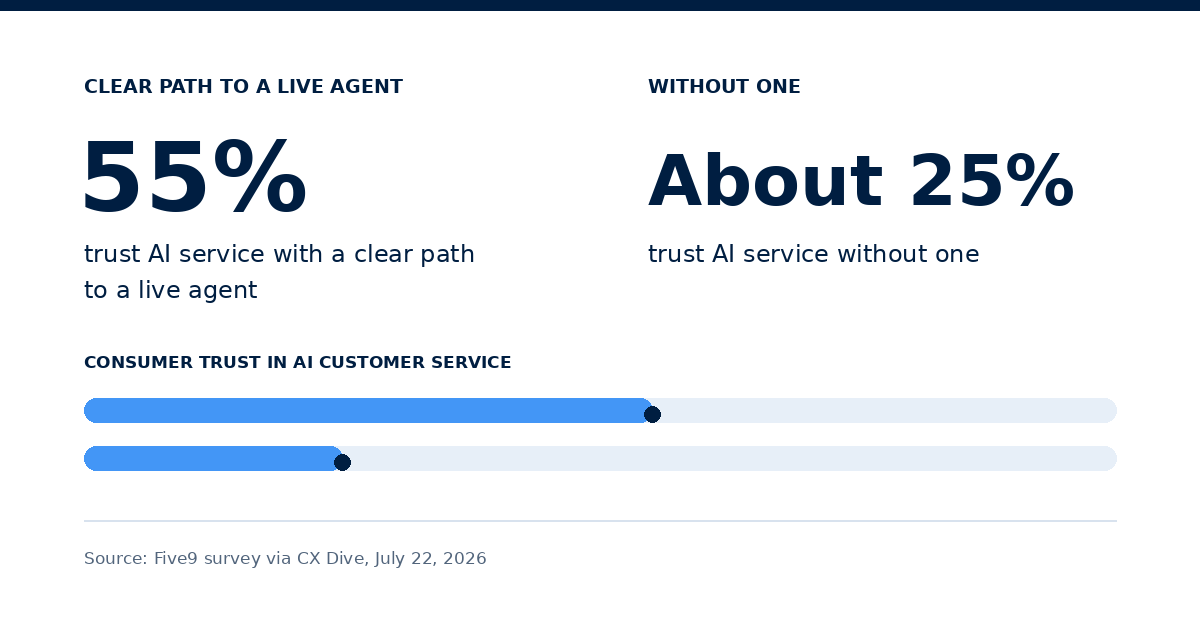
55% trust AI service with a clear path to a live agent. About 25% trust it without one.
Five9 survey via CX Dive, July 22, 2026
The path to a person is what makes the automation acceptable to customers in the first place.
Where automation fits in regulated queues
There’s plenty of routine volume in utility and government contact centers, and it’s worth automating well:
- Restoration-status updates during a large outage.
- Balance and due-date lookups.
- Payment confirmations and receipts.
- Appointment and program-deadline reminders, sent with the consent your rules require.
TSI CXBPO uses automated status updates on routine outage calls so agents can stay on the calls that need them.
How to design the path to a person
If the path to a human is the trust feature, design it like one.
Route by intent and by flag. A caller on a medical baseline list, a report of a downed wire, or the words “disconnect” or “shut off” should skip the bot, however the call starts.
Say it’s automated. About 75% of consumers in the Five9 survey want to know when content is AI-generated (CX Dive, July 22, 2026). The FCC treats AI-generated voices as artificial voices under the TCPA (FCC declaratory ruling, February 2024), so outbound use carries consent rules too.
Make the hand-off warm. The agent should see what the caller already said, so no one has to repeat a hardship story twice.
Keep the file. For regulated calls, the recording, the notes and the script version in use that day are what you’ll produce if a commission or an auditor asks.
The people on the other end
The calls AI can’t take are the ones where the customer is having a bad day: no power, no heat, a bill they can’t pay, a notice they don’t understand. The people who answer them need training in the programs and the rules, and the patience to walk someone through both.
TSI CXBPO runs those conversations for utilities and government agencies: arrears, disconnection, payment arrangements and resident contact lines, inside a parent licensed or registered in every state that requires it and authorized to collect in all 50 states, DC and Puerto Rico that holds one of five seats on the US Treasury Bureau of the Fiscal Service private collection agency panel. Training Magazine has ranked TSI’s training organization in its worldwide Top 10 for four consecutive years.
If you’re drawing the line between automated and human in a regulated contact center, we’d be glad to compare notes: talk to the TSI CXBPO Team.